
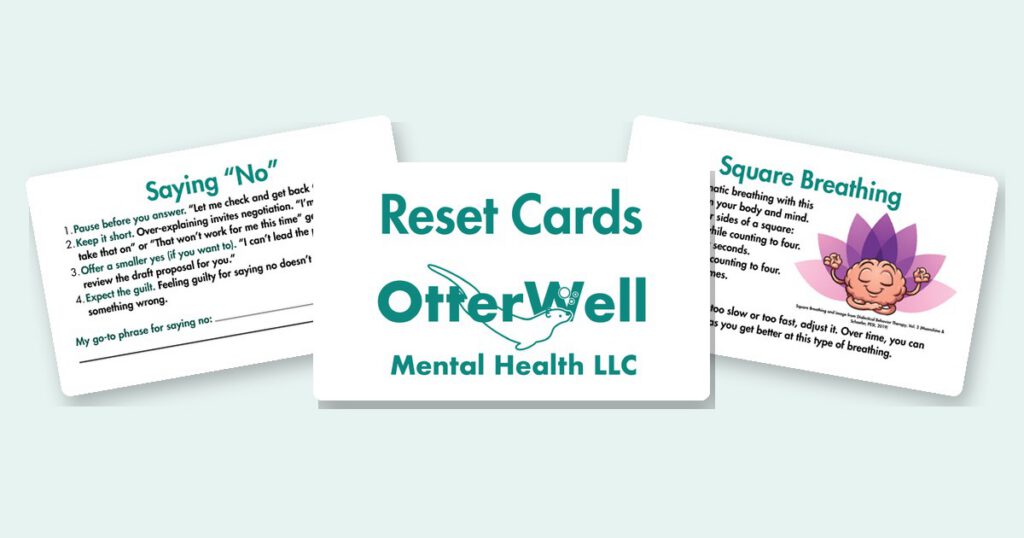
Welcome to the Reset Cards Resource page! On this page you’ll find a printable PDF version of the Reset Cards, my coping skills cards, as well as links to related blog posts and additional resources. Additional Reset Cards or resources might be added in the future, so be sure to check back for the latest additions.
About the Reset Cards
The Reset Cards were designed to put helpful tools in a quick, user-friendly format for the people everyone depends on. You can use these before or after a difficult task or interaction, as a way to start your day positively, or whenever you need a little extra support to get through the day.
You’re welcome to print the Reset Cards for your own use and to share a link to this page with anyone who might benefit. Please don’t reproduce or distribute them without my written permission. Contact me if you’d like to use them with your clients or students.
The Reset Cards were designed to be printed as 3″ x 5″ double-sided cards with a hole punched in the upper left corner, held together with a binder ring. Have your printer flip the paper on the short edge to print on both sides and print at 100% or “actual size.” Use the gray marks as cutting guides.
Reset Cards Resources
Self-Soothe Kit
The purpose of the Self-Soothe Kit is to pull together items you can use to soothe yourself in difficult moments, like when you narrowly escape a grocery store tantrum with your toddler only to have to drive home listening to them cry and scream for the 10 minutes it takes to pull into your driveway. All because you didn’t buy them that silly impulse purchase toy strategically placed at the register.
By identifying and gathering items that soothe all five of your senses, you can immediately start using your Self-Soothe Kit to take the edge off and regroup. No searching through your house to find your favorite hard candy or scented candle. No trying to think of soothing music when all you want to do is scream along to some punk rock with language you wouldn’t want your co-workers to hear.
Dr. Cathy Moonshine and I provide a variety of Dialectical Behavior Therapy tools, puzzles, coloring pages, and worksheets in Dialectical Behavior Therapy, Volume 2, Second Edition: More than 275 Worksheets, Activities & Games for Acquiring Competency in DBT. While Volumes 1 and 2 were designed to help clinicians gain proficiency in DBT, the activities and worksheets in Volume 2 are perfect for anyone trying to learn new skills to cope with life challenges or increase their wellbeing.
You can read more about Volume 2 on the PESI website or on Amazon.
Saying “No”
Read more in the blog post How to stop saying “yes” when you really mean “no.”
Square Breathing
Square Breathing is a Mindfulness technique that uses diaphragmatic breathing (also known as “belly breathing”) to help calm your body and mind, bringing you back into the present.
There are a variety of mindfulness exercises, and many build on the foundation of diaphragmatic breathing. Square Breathing is an excellent introductory exercise that only requires a few moments to complete.
Use diaphragmatic breathing to do the following:
- Breathe in while counting to four.
- Hold for four seconds.
- Exhale while counting to four.
- Repeat four times.
If counting to four feels too fast or too slow, adjust the pace. Increase the length of the first three steps as you get better at Square Breathing.
You can easily do Square Breathing anywhere, usually without anyone even noticing what you’re doing. It’s perfect for taking a beat before you snap back at your partner for asking you where the car keys are for the millionth time this week (“On the kitchen counter” instead of “On the kitchen counter where you left them when you came home last night. Stop expecting me to track everything for you! ARGH! I’ve had it!”).
Square Breathing also comes from Dialectical Behavior Therapy, Volume 2, Second Edition: More than 275 Worksheets, Activities & Games for Acquiring Competency in DBT (linked above, under Self-Soothe Kit).
Delegate
Remember, not everything has to be done perfectly, or done by you. “Good enough” is often plenty, especially when handing a task to someone else frees you up for the things only you can do.
The world probably won’t end if your kids have pizza for dinner tonight instead of a perfectly balanced meal. They’ll likely be thrilled, and you’ll get back an extra 30 to 60 minutes for something that matters more, even if that something is finally sitting down.
If handing things off feels impossible because you’re the one everyone counts on, therapy for people-pleasing and boundaries can help you loosen that pattern.
Done List
Sometimes you forget about all the tasks you accomplish in a day, and then you wonder why you are so tired. Maybe you answered 40 emails, covered for a coworker who called in sick, and calmed down an upset client. You still head home feeling like you accomplished nothing because the report didn’t get finished.
A Done List helps you see the whole picture. Write down what you’ve already done, not what’s left. I bet you did more by noon than most people do in 48 hours. Your “To Do” list will never be completely finished anyway, so give yourself credit for the progress you’re making.
If you’re tired in a way a good night’s sleep doesn’t fix, read more about burnout therapy.
What’s For Dinner
Are you curious about why choosing what to have for dinner can feel so difficult? Read more in the blog post “When “What do you want for dinner?” becomes the most difficult question.”
Gratitude
Learn more about gratitude and different gratitude practices at the Greater Good Science Center.
The article “Four Practices to Help You Feel More Engaged at Work” discusses practices to help build appreciation, trust, and kindness at work.
Mental Health Resources
The Reset Cards aren’t a substitute for therapy. If you’re in crisis, call or text 988 to reach the Suicide & Crisis Lifeline. You’ll find more supports on my Resources page.
If you’re a clinician wanting to learn more about DBT and how to integrate it into your practice, check out Dialectical Behavior Therapy, Volume 1, Second Edition: The Clinician’s Guidebook for Acquiring Competency in DBT at PESI or Amazon.
Next Steps
When a card isn’t enough
Some days, a few rounds of Square Breathing and a pizza night are all it takes. Other days call for more support than a card can give. I work with adults across Oregon who are the people everyone depends on and are running on empty. Therapy is a place to take some of that pressure off. Sessions are by secure video, and the first step is a free consultation.
For clinicians and organizations
If you’d like to use the Reset Cards with your clients, staff, or students, please contact me to ask about permission. I also offer training and consultation on Dialectical Behavior Therapy, burnout, curriculum design, and creating practical tools for the people you serve.