
Anxiety is trying to help you. Sometimes.
How to find the point where anxiety stops helping.
It’s 9:30 p.m. You’ve had a long and tiring day, so you decide to go to bed early and get a little bit of extra sleep to refresh yourself. You crawl under the covers, turn off your bedside lamp, close your eyes, and look forward to some rest. Instead of drifting peacefully off into dreamland, a nagging thought pops into your mind “Did I remember to turn off the kitchen light?” You try to push it away. Of course you turned off the kitchen light—you always do. Except there was that one time last month when you woke up, and the kitchen light had been on all night. You sigh and get up to check the light.
Now that’s settled, you get back in bed, close your eyes, inhale and exhale deeply, and… you start creating a mental to-do list for tomorrow. Pay bills, make sure your daughter has her school project before she leaves for the bus, stop by the store to pick up more peanut butter, send an email updating your colleague about the project meeting coming up on Thursday, call the pharmacy to refill your prescription… You open your eyes, turn on your light, and add your to-do list to the notes app in your phone.
And then the real anxiety kicks in.
You turn off your light and close your eyes again. And you start mentally rehearsing a difficult conversation you have been putting off with one of your direct reports who has been falling short with their job duties lately. You feel the tension increasing in your body as you think about the situation. You feel angry and frustrated. Your jaw clenches tight, and then the anger is replaced by a sense of foreboding.
What if they quit? How will the work get done? What if they don’t quit, and instead they start performing even more poorly? HR isn’t reliable with discipline issues. What if your boss says it’s your fault? Or worse, fires you instead because you aren’t a good enough manager? You have a horrible sensation in the pit of your stomach, and your limbs start tingling. You start to feel nauseous. Your thoughts continue this anxious spiral, and when you look at the clock, it says 11:30 p.m. So much for getting extra rest tonight.
So is anxiety helpful, or is it hurting you?
Many of us have come to think of anxiety like a guardrail that prevents us from falling off the edge. It reminds us to double-check for possible mistakes or dangers, helps us track important tasks and events, and maybe even “helps” us prepare for practically any possible outcome for situations we are faced with. And it’s not wrong, exactly, to think that way. There is a point at which anxiety helps us perform better. There’s also a point at which anxiety starts harming our performance.
I wish I could tell you there’s a specific point at which anxiety is no longer helpful and becomes harmful, and that it was the same for everyone for every task. As usual, the answer isn’t so clear-cut. If you’ve been anxious most of your life, or for an extended amount of time, it can be hard to know when anxiety crosses over from helping to hurting, or from hurting to helping.
Picture an athlete before the big game
The goal of therapy for anxiety is to manage it effectively, not eliminate it completely. Imagine an elite basketball player before a championship game. If they felt no anxiety, they might get on the court feeling nice and relaxed. Balls might go right past them, and they might feel pretty ok with the other team stealing the basketball. In other words, there wouldn’t be that increased alertness that comes from anxiety contributing to their performance.
Now imagine this same player instead feels major anxiety before the game—they feel stressed, their thoughts are in an anxious loop about how everything is riding on today’s game, their muscles are tight, and they have tunnel vision. They might be struggling to dribble due to their muscle tension, or missing open passes because of their tunnel vision. It’s not a great outcome.
Once more, I want you to imagine this player with some nervousness before the big game. They have an increase in energy and alertness from that anxiety, but not so much that they have tunnel vision. They understand the importance of the game; they are aware of their abilities, and the lower level of anxiety helps them stay aware of opportunities to get the ball into the basket.
The Yerkes-Dodson Law
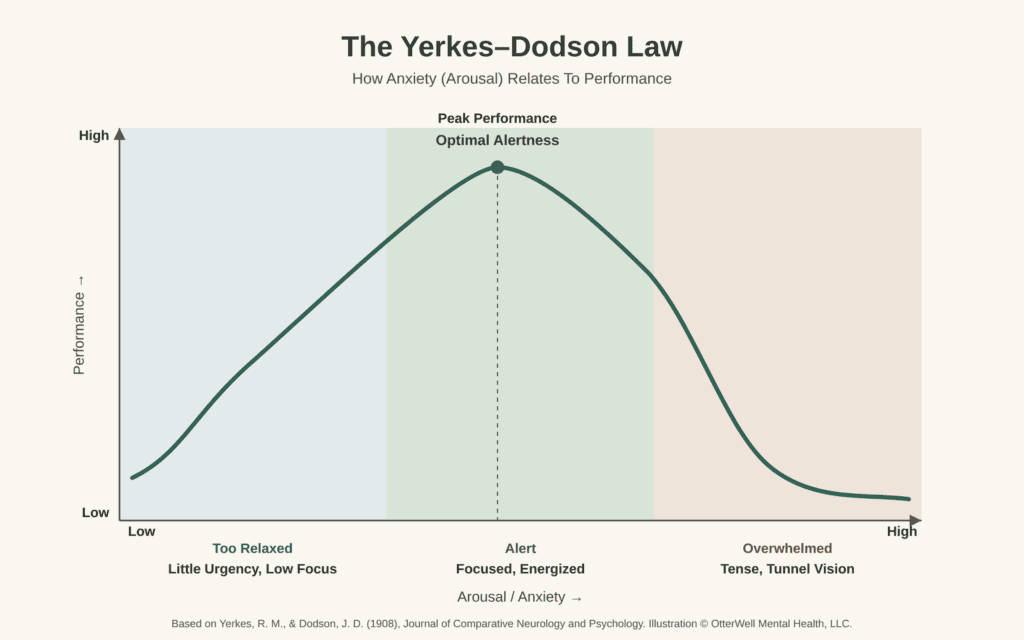
What I’ve just described to you is what psychologists call the Yerkes-Dodson law bell curve. On the X-axis (horizontal line), you have arousal (or anxiety) going from low to high (left to right), and on the Y-axis (vertical line), you have performance going from low to high (bottom to top). The optimal performance is the top of the bell curve, where performance and arousal (or anxiety) meet at the highest point. This means your performance is at the peak (or top) with that amount of arousal (anxiety). Less or more than that leads to less optimal performance.
What do I do with that information?
You’re probably saying “That’s nice, Dr. Stephanie, but what am I supposed to do with this bit of psychology nerd information?” I’m so glad you asked! If you are feeling too anxious, it’s important to use strategies to help decrease your arousal. This might include going for a walk or other physical activity prior to having that difficult conversation I mentioned earlier. It might mean talking to your therapist (or finding one if you don’t already have one) about what’s keeping you anxious.
On the other end of the curve, if you’re feeling too relaxed about something (I know, probably not you since you’re reading an anxiety blog post!), you can make a boring task more challenging (perhaps doing squats in between folding your towels?) or find a buddy to help make it feel less like a mundane task and more like socializing.
How therapy helps you find your peak
I’m going to guess there are a number of you who are already arguing with me about the idea that anxiety might not always be helpful for you. The truth is, when we respond with high arousal repeatedly, it takes a toll on us emotionally, physically, and cognitively. Our brains and bodies weren’t designed to experience high anxiety frequently and for extended periods of time. Again, I’m not here to help my clients get rid of all their anxiety. My job as a therapist is to help my clients figure out their point of peak performance and how to manage the anxiety that threatens to take them past that point. If you’re ready to start managing your anxiety instead of letting it manage you, let’s talk. You can book a free consultation or read more about how I work with Anxiety.