
What does burnout recovery look like?
Last time, it was a rainy Wednesday, the new graduate was running circles around you, and you were starting to feel like a slow old dinosaur. If you recognized yourself in “Am I losing my edge or is this burnout?,” you might be wondering what burnout recovery actually looks like. Maybe your big plan is to drag yourself through the holiday season, when you might get an extra couple of days off to “rest” and recharge, or plan a vacation. Perhaps you’re waiting to see if that fancy new spa you heard about is going to start offering some specials so you can have a day of pampering. Self-care is important, right? Those wellness folks at work are always talking about it.
Remember that vacation that already felt like a lifetime ago? How many times have you returned to work after a vacation or a long weekend, only to find increased frustration and a feeling that you just made more work for yourself by being away? In fact, your high-achieving nature probably means your boss and colleagues decided not to cover all your tasks because you’re “better” at them and they knew you’d take care of anything left incomplete when you came back. Lucky you. That sense of peace from your time away? It evaporated within 30 minutes of returning to work, and now your “to do” list has doubled. Thanks, team. Research backs this up: the benefits of time off usually fade within the first week back at work (de Bloom et al., 2010).
Why a vacation doesn’t fix burnout
Your job (or your overflowing inbox) is the stressor, and stress is your body’s response to it. A vacation can take the stressor away for a while, without doing anything about the stress your body is still carrying. Drs. Emily and Amelia Nagoski offer a helpful way to think about this in their book Burnout: The Secret to Unlocking the Stress Cycle (2019): your body needs to complete the stress cycle, a signal that the threat has ended. You can do this through physical activity (the most efficient option), slow breathing, positive social contact, laughter, affection, a good cry, or creative expression. If you don’t complete the stress cycle, your jaw might stay clenched and you might continue lying awake at 2 a.m., hanging onto the stressors you faced previously.
What kind of rest helps
While having time to yourself, or engaging in self-care, can be helpful in the short term, burnout is a long-term problem. That means recovery can take time and effort to achieve, and rest needs to be more intentional than lying on your couch, scrolling for an hour before bed. Research on recovery from work describes four experiences that make time off restorative: detaching from work, relaxation, mastery (like learning something new), and control (like choosing how you spend your time) (Sonnentag & Fritz, 2007).
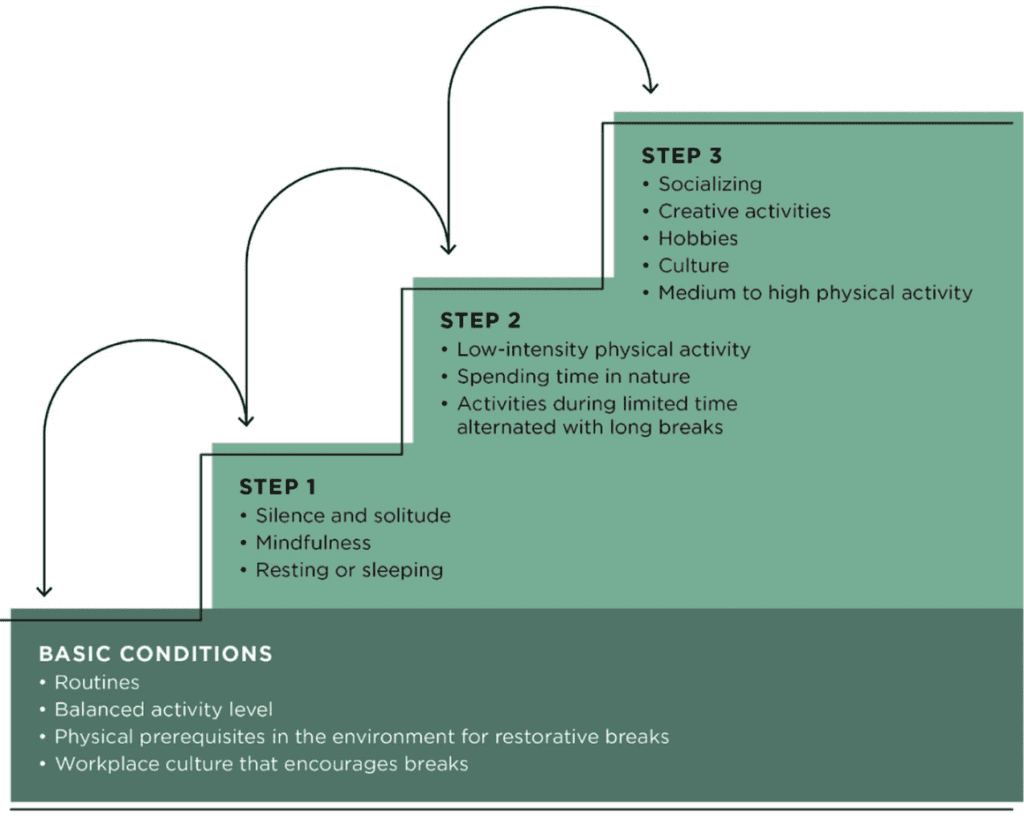
What you find helpful in recovering from burnout is likely to change over time. At first, you might find low-effort activities for longer periods of time helpful. This could include frequent or extended sleep, cuddling a pet, or sitting outside with no screens. Later, you might find shorter or more active recovery strategies work better for you and your life, like exercise, spending time with your friends, or taking on a new hobby (Aronsson et al., 2024). The graphic below, from a Swedish study, shows how the kinds of rest that help can shift as recovery goes on.
How long does burnout recovery take?
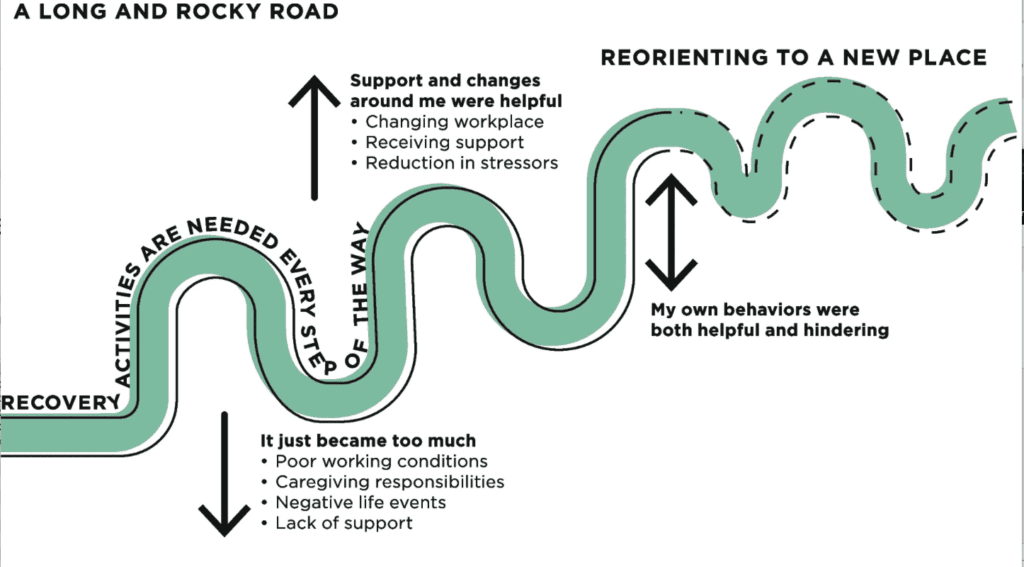
Burnout recovery usually takes months, not a long weekend, and it tends to take longer the longer burnout has gone on. How long it takes also varies a lot from person to person. In a Swedish study of people with severe, clinical-level burnout, many of them on long-term medical leave, about a third were still clinically exhausted seven years later (Glise et al., 2020). And if you’re thinking “Oh, my burnout isn’t that bad, I can wait a little longer,” researchers have found that the longer someone waited to seek treatment, the longer it took them to recover (Glise et al., 2012). As the graphic below from Aronsson and colleagues’ study shows, burnout recovery isn’t a static, linear process.
Recovery usually means something changes at work
If you truly want to recover from burnout, you’re going to have to address the elephant in the room: work. The six areas from my last post (workload, control, reward, community, fairness, and values) are a good place to start looking for what needs to change. In a Swedish study that followed people for seven years after treatment for clinical burnout, most had made some kind of change at work (Beno et al., 2021). That might include changing workplaces, adjusting your responsibilities, reducing your hours, finding support, or setting (and holding) boundaries (Aronsson et al., 2024).
This might feel overwhelming or impossible, especially at the start of your burnout recovery process, and you may want some support in exploring potential options. That’s where therapy for burnout can help. When I work with clients who are burned out, we figure out which kinds of rest actually help them and what needs to change at work so their recovery lasts.
References
Aronsson, I., Stigsdotter Neely, A., Boraxbekk, C.-J., Eskilsson, T., & Gavelin, H. M. (2024). “Recovery activities are needed every step of the way”—Exploring the process of long-term recovery in people previously diagnosed with exhaustion disorder. BMC Psychology, 12, Article 248. https://doi.org/10.1186/s40359-024-01756-z
Beno, A., Hensing, G., Lindegård, A., & Jonsdottir, I. H. (2021). Self-reported changes in work situation – a cross-sectional study of patients 7 years after treatment for stress-related exhaustion. BMC Public Health, 21, Article 1222. https://doi.org/10.1186/s12889-021-11242-5
de Bloom, J., Geurts, S. A. E., Taris, T. W., Sonnentag, S., de Weerth, C., & Kompier, M. A. J. (2010). Effects of vacation from work on health and well-being: Lots of fun, quickly gone. Work & Stress, 24(2), 196–216. https://doi.org/10.1080/02678373.2010.493385
Glise, K., Ahlborg, G., Jr., & Jonsdottir, I. H. (2012). Course of mental symptoms in patients with stress-related exhaustion: Does sex or age make a difference? BMC Psychiatry, 12, Article 18. https://doi.org/10.1186/1471-244X-12-18
Glise, K., Wiegner, L., & Jonsdottir, I. H. (2020). Long-term follow-up of residual symptoms in patients treated for stress-related exhaustion. BMC Psychology, 8, Article 26. https://doi.org/10.1186/s40359-020-0395-8
Nagoski, E., & Nagoski, A. (2019). Burnout: The secret to unlocking the stress cycle. Ballantine Books.
Sonnentag, S., & Fritz, C. (2007). The Recovery Experience Questionnaire: Development and validation of a measure for assessing recuperation and unwinding from work. Journal of Occupational Health Psychology, 12(3), 204–221. https://doi.org/10.1037/1076-8998.12.3.204